
Overview
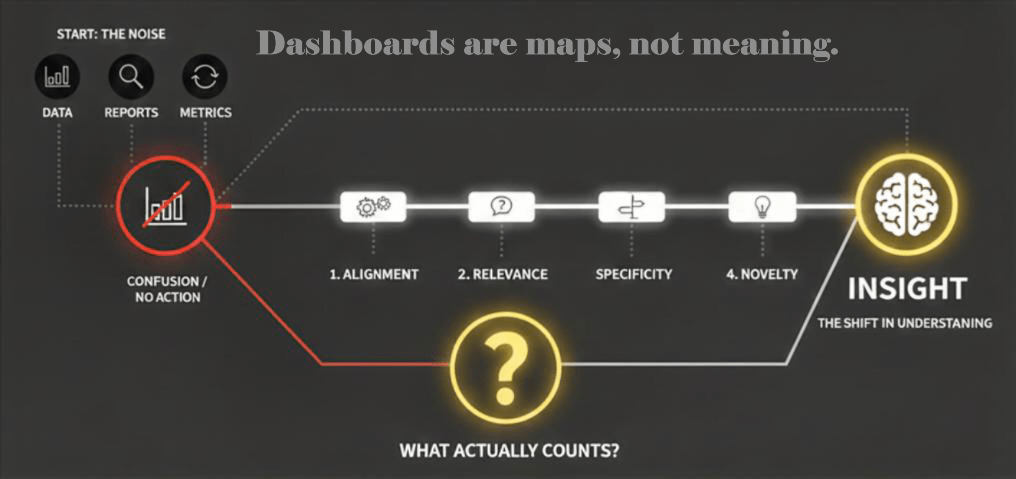
This research note examines what qualifies as a genuine business insight and why many organisations confuse data representation with meaningful understanding. Drawing on decision science and analytical practice, it outlines a four part framework for distinguishing actionable insight from noise.
Core Argument
Many organisations label metrics, dashboards, or correlations as insights, yet these outputs rarely influence decisions. An insight is not a number. An insight is a shift in understanding that changes how a problem is perceived and what actions follow. Without this cognitive shift, information remains descriptive rather than interpretive.
Four Criteria of High Quality Insight
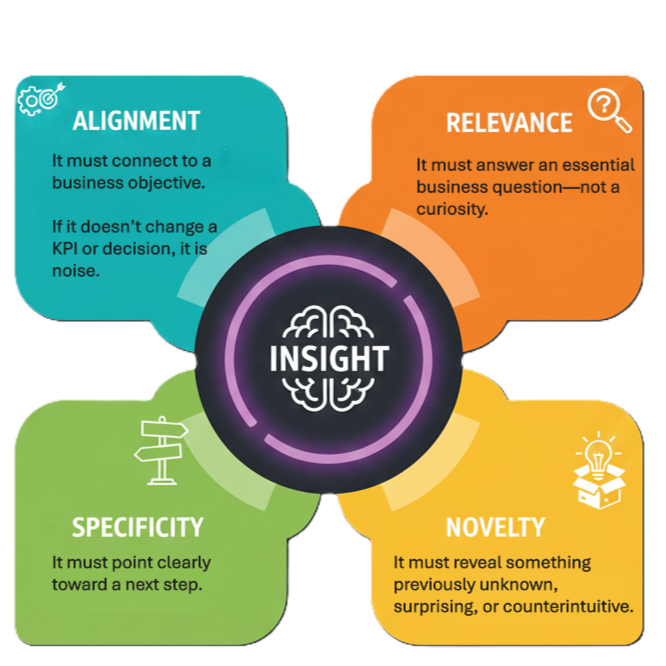
A finding qualifies as an insight only when all four conditions below are met.
1. Alignment
The insight must connect to a decision, priority, or organisational objective. Information without alignment does not inform action.
2. Relevance
The insight must answer a meaningful question. Organisations often collect extensive data yet fail to ask the questions that make interpretation possible.
3. Specificity
The insight must clarify what action should be taken. General observations are not sufficient for decision-making. Specific insights identify the cause, the segment, and the direction of action.
4. Novelty
The insight must reveal something previously unknown. Novel findings challenge assumptions, expose hidden patterns, and open new strategic pathways.
Why Organisations Often Fall Short
Across reviews of dashboards and reports, the same pattern appears. Alignment is missing, relevance is partial, specificity is rare, and novelty is almost absent. As a result, many outputs remain descriptive rather than cognitive. Insight is not the chart. Insight is the new understanding that emerges from it.
Insight as a Cognitive Shift
A true insight changes the mental model of an organisation. It reframes assumptions, highlights overlooked drivers, or exposes constraints not previously recognised. If thinking does not change, the finding does not qualify as an insight.
Conclusion
Insight is one of the most misunderstood assets in contemporary organisations. Data is abundant, but meaningful understanding is scarce. High quality insight is aligned, relevant, specific, and novel, and it reshapes decision-making capacity. Organisations that adopt this evaluative discipline gain a significant advantage in environments defined by uncertainty.
References
Chen, H., Chiang, R. H., and Storey, V. C. (2012). Business Intelligence and Analytics. MIS Quarterly, 36(4), 1165–1188.
Davenport, T. H. (2018). Analytics at Work. Harvard Business Review Press.
Kahneman, D. (2011). Thinking, Fast and Slow. Farrar, Straus and Giroux.
Sivarajah, U., Kamal, M. M., Irani, Z., and Weerakkody, V. (2017). Critical Analysis of Big Data Challenges. Information Systems Frontiers, 19(2), 281–300.
STL Digital. (2022). Business Insights Generation and Consumption.
 Insight