
Case study · Decision system
Heagital Market Decision Engine
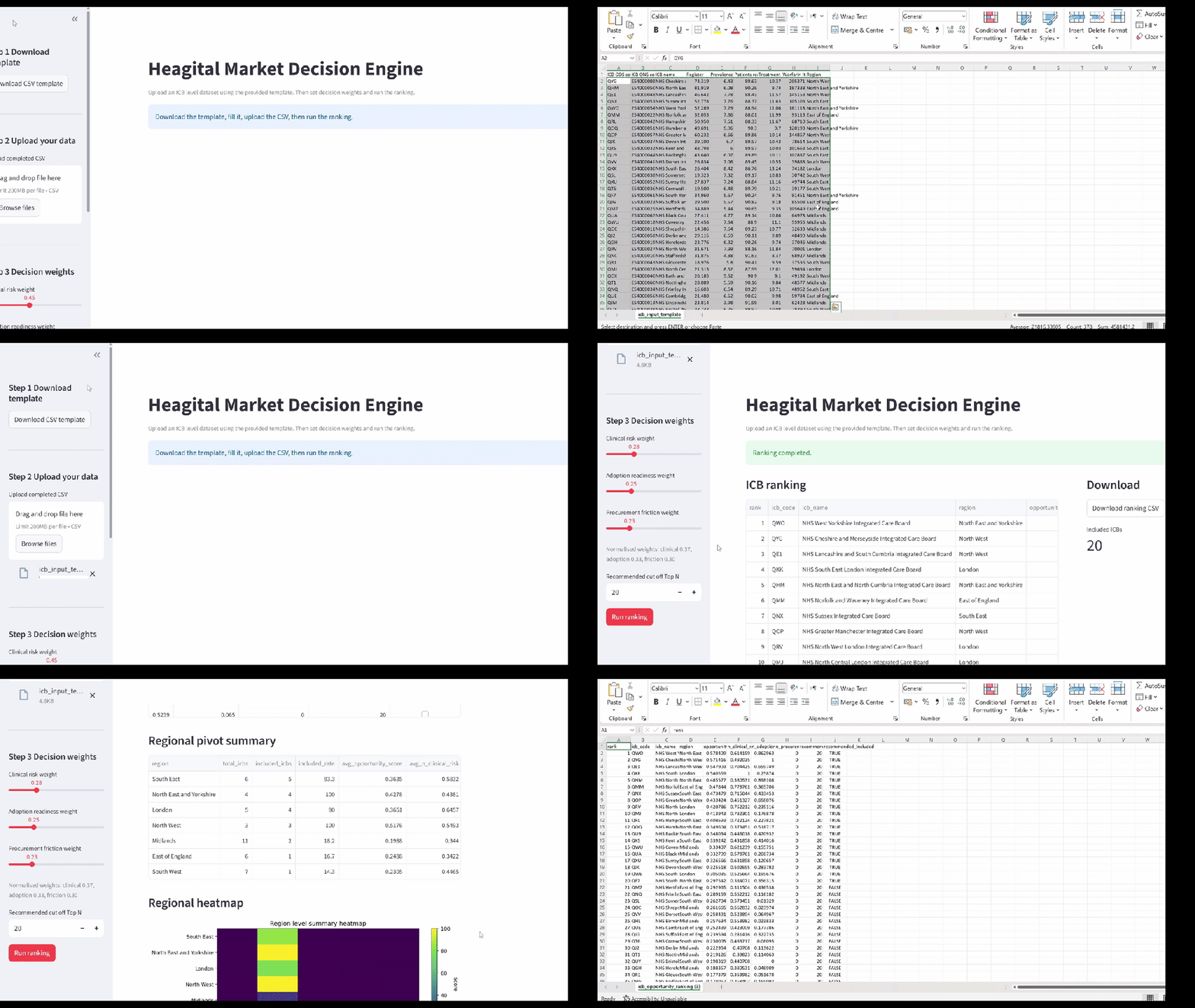
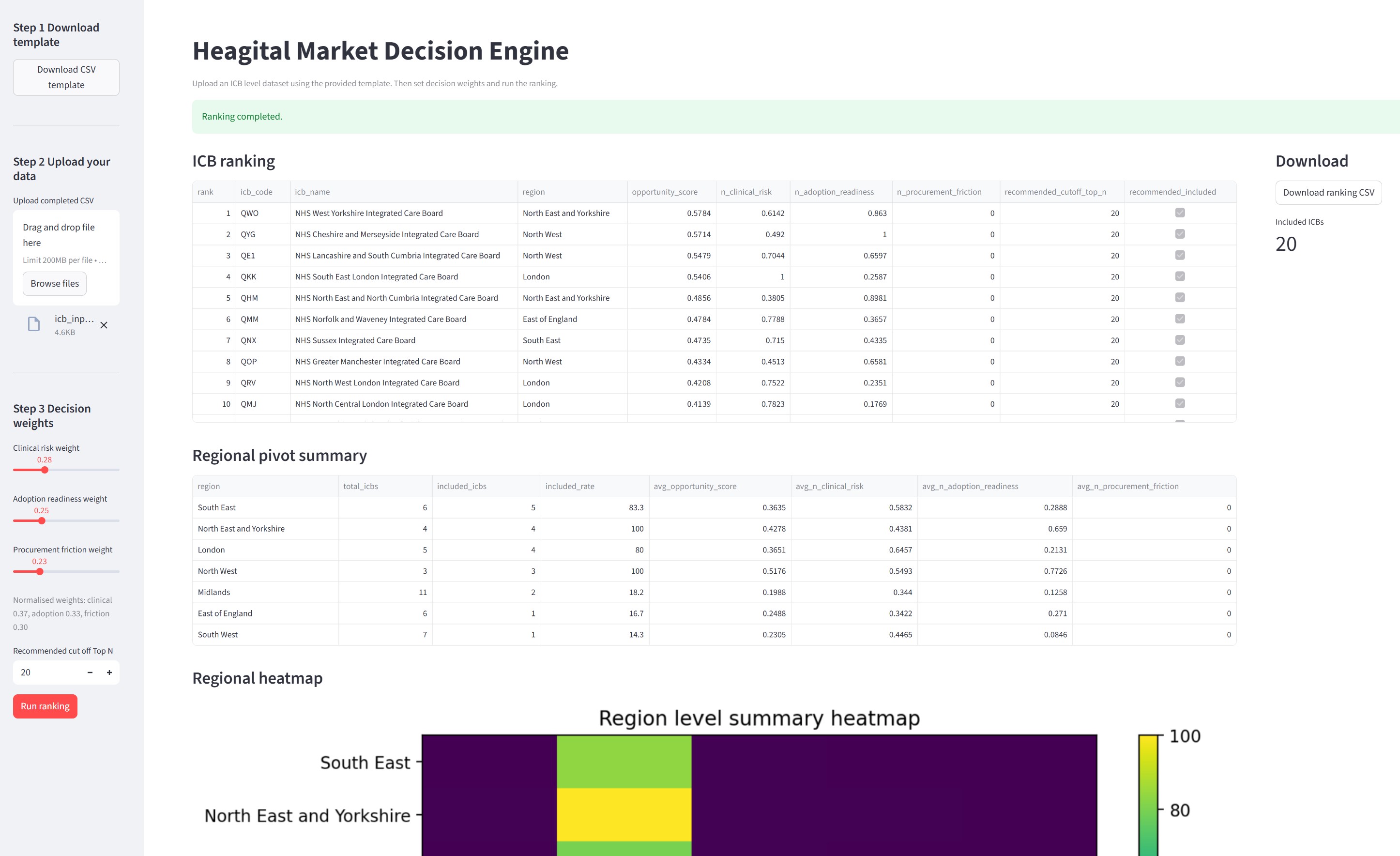
A parameterised decision system that ranks all 42 NHS Integrated Care Boards and converts fragmented healthcare data into an auditable market entry plan. I designed and built it as sole author. It now informs board-level rollout decisions at Heagital.
42
NHS Integrated Care Boards ranked
53.4%
of national addressable opportunity in the pilot region set
~6.7M
PT INR tests per year (England TAM)
The context
Heagital is a UK MedTech startup developing a connected PT INR point-of-care testing solution. At an early commercial stage the company had no agreed go-to-market direction, no prioritised NHS regions, and no validated channel assumptions. Rollout decisions risked being driven by intuition.
The NHS data needed to make those decisions exists, but it is fragmented across registries, prescribing datasets, and demographic releases. No off-the-shelf tool turns it into a ranked, defensible entry plan. So I built one.
My contribution
I am the sole author of the system: the decision model, the data pipeline, the scenario engine, and the code. This is not a market report. It is a piece of decision infrastructure that the company re-runs as strategy or data changes.
The design choice that matters most is auditability. Every ranking traces back to explicit weights and named public datasets. A board member can ask why a region ranks third and get a numerical answer, not a judgement call.
How the engine decides
Each Integrated Care Board is scored on three pillars. The decision-maker sets the weights, and the weights must sum to one. They encode strategic intent, not statistical tuning.
OpportunityScore(ICB) =
W1 × Normalised(Clinical Risk)
+ W2 × Normalised(Adoption Readiness)
− W3 × Normalised(Procurement Friction)
where W1 + W2 + W3 = 1
Inputs are ICB-level quantitative features: AF register size, treatment gap, Warfarin prescribing as a readiness proxy, population aged 65 and over, and testing intensity indicators. Inputs are treated as state-of-world data, not assumptions. The whole pipeline runs from a single reproducible CLI command.
Scenario and sensitivity analysis
The engine ships with four scenario configurations representing different strategic postures, from clinically led to procurement led. Re-ranking under each scenario produces sensitivity signals: regions that stay near the top under every configuration are robust entry candidates, and regions whose rank swings are fragile. This separates decisions that are safe from decisions that depend on a strategic bet.
Commercial impact
- Adopted at board level as the basis for Heagital’s UK rollout sequencing
- A ranked rollout list of all 42 ICBs with a recommended market entry cut-off
- A pilot region set covering 53.4% of the national addressable opportunity
- A clinically grounded England TAM of approximately 6.7 million PT INR tests per year
- One non-obvious result: London ranked lowest due to higher DOAC uptake, overturning the default assumption that the capital comes first
Data inputs
- NHS England QOF 2023 to 24 AF indicators at Integrated Care Board level
- NHSBSA Warfarin prescribing volumes
- ONS demographic segmentation including age 65 and over
- NICE clinical guidance for PT INR testing frequency
Technologies used
Python · Weighted scoring model · NHS QOF data · Reproducible CLI pipeline · Streamlit · Pandas
 Hoda Rezvanjoo